 Michael Caine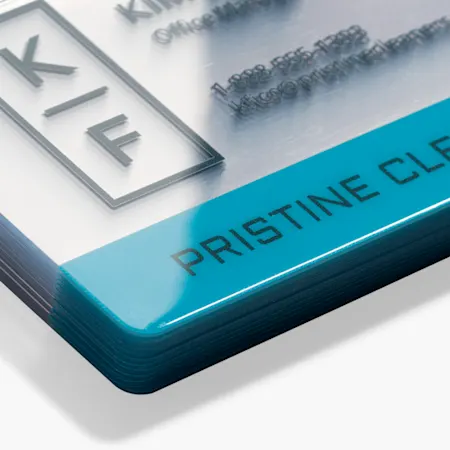
What happens to your business card after you hand it over?
Most business owners never ask the question, yet the answer decides whether a strong introduction becomes a paying client or just another forgotten name in someone’s card stack. 72% of people judge a company’s quality directly from the business card they receive, and the verdict forms before they ever visit your website or read a review.
Billions of business cards are printed each year, and around 88% are discarded within a week. Plastic cards last far longer because they feel worth keeping, and a card still sitting in a wallet keeps selling your brand weeks after the paper ones have gone in the bin.
1. It Makes A Premium First Impression Before You Speak
Plenty of professionals rehearse their pitch for hours, then choose their business card in minutes. The imbalance costs them because a card lands in the prospect’s palm before the pitch is ever spoken. How the card feels shapes the first read on your business, and undoing a physical impression is far harder than correcting a spoken one.
Plastic carries the rigidity and weight of a credit card. The familiar substance signals credibility the instant someone takes it from you. Paper bends under the same grip, and the flex works against the professional image you built.
What each card communicates the moment it is handed over
| Features | Paper Card | Plastic Card |
| Feel in hand | Flexible, lightweight | Rigid, credit-card weight |
| Brand association | Ordinary, replaceable | Established, credible |
| Stands out in a stack | Rarely | Consistently |
| Perceived investment | Minimal | Deliberate and considered |
2. Keeps Your Brand Alive Long After You Walk Away
Your card only works if it lasts until the person actually needs you. Paper seldom does. It softens, curls, and fades through ordinary wallet use, leaving the card someone pocketed three weeks ago unreadable by the time they reach for it.
Plastic cards are built from PVC, the same material behind credit cards and driver’s licenses. They resist water, scratches, and bending through months of daily handling. Give one out in January, and it looks identical when a prospect digs it from a drawer the following autumn.
The average business card lasts just 5 to 7 days, but cards printed on distinctive materials last roughly twice as long. The extra lifespan is the difference between a card already in the bin and one still in the wallet when the buying decision arrives.
Why a longer lifespan strengthens brand recall
- Every day your card stays in a wallet, your logo gets seen when the person reaches for another card
- Each sighting builds recognition without costing you anything past the first print run
- Two cards cost the same to print, but only the six-month one is still earning attention, while the six-day one is long gone
3. Shows Off Your Brand in Color and Detail Paper Cannot Match
How a card looks matters as much as how it feels. On plastic, your design gets a surface paper cannot rival. Ink sits differently on PVC, producing brighter colors and crisper edges at sizes where cardstock blurs.
Clarity matters most for your logo and brand colors. The same logo reads as merely acceptable on paper, yet sharp and polished on plastic, and the contrast registers the second someone sets your card beside the rest.
Plastic also allows finishes that paper cannot reproduce. Each one offers your brand a fresh way to look distinct.
Finishes that turn a card into a brand statement
| Finish | What it does for your brand |
| Clear or frosted | Makes your logo appear to sit on a see-through background |
| Full-bleed color | Runs your design edge to edge with no plain borders |
| Foil stamping | Adds metallic accents holding their shine for years |
| Custom die-cut shape | Outlines the card part of your identity |
| Embossed lettering | Gives raised text a tactile quality that paper cannot hold |
4. Turns One Card Into a Brand People Refuse to Throw Away
The surest way to make a card memorable is simple: give the recipient a reason to keep it. One plastic card holds far more than contact details. Every extra function you build in makes the card harder to toss.
Look at one of the most recognized brands in the world for proof. Starbucks grew its customer base on a physical plastic card sitting in millions of wallets, seen every time someone reached for cash or another card. Constant visibility kept the brand familiar and pulled customers back in.
How different businesses make one card do several jobs
Restaurants and cafes
- Front holds the name, location, and social handles
- Back holds a loyalty stamp tracker or a standing discount
- Customers keep it to collect rewards and see your brand daily
Contractors and trades
- Front holds the name, license number, and contact details
- Back holds a QR code linking to a portfolio of finished work
- The card becomes a reference instead of a disposable slip
Salons, gyms, and clinics
- Front holds the brand and booking details
- A magnetic stripe doubles as a check-in or membership card
- One card handles the introduction and ongoing access
5. The Card Reflects Who Your Brand Is
Good cards do more than lay out contact details neatly. They tell a prospect what sort of operation you run before a word is read, and plastic lets you control the message instead of leaving it to chance.
Clear plastic suits a window cleaning service, because the see-through card points straight to the work. Frosted stock and silver foil fit a high-end brand. Die-cut shapes let a creative studio prove originality that paper printers cannot produce. In every example, the card communicates the brand, not only the contact details.
Design choices that keep a plastic card on-brand
- Run your brand colors at full saturation, since plastic reproduces them far more vividly than paper
- Keep the front uncluttered, letting the logo and name be the first things people notice
- Reserve the back for one function, whether a loyalty tracker, an offer, or a QR code
- Match the finish to your brand, with frosted reading as upscale and clear reading as modern
6. Delivers Lasting Brand Value at a Lower Long-Term Cost
Plastic costs more per card than basic paper. The per-card price is where most comparisons wrongly stop. Add up a full year, and the numbers favor plastic.
Paper supplies get reordered often because cards wear out, look dated in a box, or arrive creased. Plastic holds its quality for years, cutting how often you reorder and keeping your look consistent from the first card to the last. Measured by each impression the card actually makes, plastic ends up far cheaper than paper.
Plastic against premium paper, measured honestly
| Feature | Basic Paper | Premium Paper | Plastic |
| Cost per card | Low | Medium to high | Medium |
| Lifespan in a wallet | Days | Weeks | Months to years |
| Waterproof | No | No | Yes |
| Multi-function ready | No | No | Yes |
| Long-term cost per impression | High | Medium | Low |
Bottom Line
Every introduction you make is only as strong as what the other person keeps afterward. The businesses that stay memorable are rarely the ones with the smoothest pitch. They are the ones whose card is still intact, visible, and easy to find when the moment to hire arrives. From durability and design flexibility to stronger brand recall, plastic business cards continue working long after the first conversation ends.
For businesses looking to create that kind of lasting impression, Duracard offers a wide range of custom plastic business card options designed for everyday use and long-term visibility. You can choose from finishes such as clear, frosted, foil-stamped, or custom-shaped cards, preview your design online, and see pricing updates as you customize. With USA-made production and fast turnaround times, it’s an easy way to create a card that reflects the quality of your brand and stays memorable for the right reasons.